
WealthScape API
Account Aggregator framework, mutual fund connect, and financial insights.
What's in WealthScape
WealthScape is SignCare's financial data platform, built on top of India's Account Aggregator (AA) framework and extended with mutual fund, demat, equity, and deposit data sources. It seamlessly integrates diverse financial data streams — bank deposits, mutual funds, equity holdings, and more — powered by AA Connect, MFC Connect, and market data sources.
Use it to power:
- Loan underwriting and credit decisioning
- Wealth management dashboards
- Personal finance apps
- Financial insights and risk scoring
Why WealthScape?
Comprehensive financial insights
Combine bank statements, mutual fund holdings, and equity portfolios into a holistic view of a user's personal finances. Track transactions, balances, and key investment activities in real time so users can make informed decisions.
Extensive financial data integration
Pull data from a wide range of financial institutions and data sources via AA Connect and MFC Connect — banks, brokerage firms, mutual fund providers, and market data platforms — through one unified API.
Full spectrum of asset coverage
Bank accounts, mutual funds, equities, ETFs, NPS, insurance, deposits, and more — all addressable through the same surface so users can monitor and manage their entire financial portfolio in one place.
Endpoint families
- Subscription — User consent lifecycle (create, pause, revoke)
- AA Connect — Account Aggregator flows: consents, FI requests, account data
- MFC Connect — Mutual fund consolidated account statement (CAS) flows
- Net Worth — Aggregate financial position across accounts
- Deposit Insights — Savings, recurring, and term deposit analytics
- Mutual Fund Insights — Holdings, performance, allocation
- Demat Insights — Demat account positions and transactions
- Equity / ETF Insights — Stock and ETF holdings, returns
- NPS Insights — National Pension System data
- Insurance Insights — Insurance holdings aggregation
- Credit Data — Integrated credit view
- F&O — Derivatives positions
- Nudges and Cohorts — Behavior-based analytics
See how WealthScape can help you
Deposit Insights
Data analytics and aggregation of bank deposit data — savings, recurring, term.
Mutual Fund Insights
Aggregation of mutual fund holdings, performance, and allocation data.
Equity Insights
Aggregation of equity holdings, transactions, and returns.
ETF Insights
Holdings and analytics for exchange-traded funds.
Credit Data
Integrated credit view and credit insights for underwriting.
Insurance Insights
Aggregation of life, general, and policy-level insurance holdings.
Base URLs
| Environment | Base URL |
|---|---|
| Stage / UAT | https://uat-ext.signcare.io |
| Production | https://ext.signcare.io |
WealthScape endpoints are prefixed with /pfm/api/v2/ or /pfm/api/v3/ depending on the endpoint — see the individual references.
Authentication
WealthScape uses the same header-based auth as Core:
Credentials are shared across Core and WealthScape — if you have Core access, you may or may not have WealthScape access depending on your contract. Check with your account manager.
Architecture
WealthScape sits between your application and India's financial data ecosystem — ingesting bank accounts, mutual fund holdings, demat positions, equity trades, and deposit data through a unified API surface.
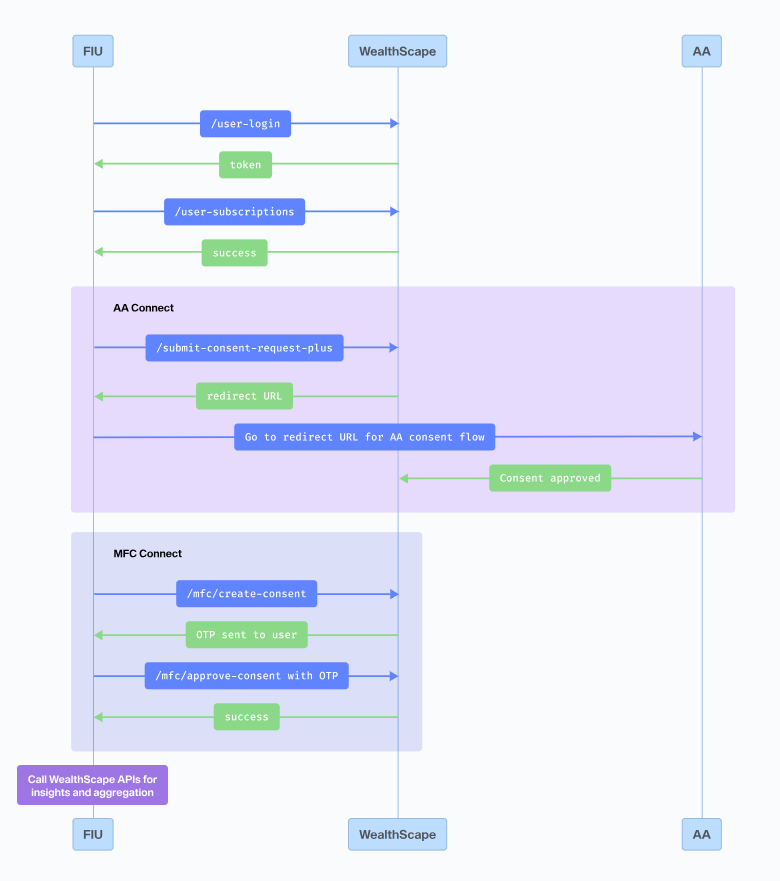
The AA consent flow
Most WealthScape operations depend on the user having granted consent via the Account Aggregator framework:
- Create consent request — specify which financial data you need and for how long.
- User approves — user is redirected to their AA's interface to approve.
- FI request — once approved, request the Financial Information from the FIP (bank, MF registrar, etc.).
- Data ready — webhook fires when data is available.
- Fetch data — pull the consented data via the AA Data endpoint.
Each endpoint in the reference explains where it fits in this flow.
Webhooks
Most AA and MFC flows are asynchronous. Configure webhooks to be notified when consent states change, FI data arrives, or long-running operations complete. See the general Webhooks guide.
Getting started
- Request WealthScape access from your account manager.
- Configure your webhook URL for consent and FI notifications.
- Start with Subscription → Submit Consent Request to understand the core flow.
- Browse individual endpoint references in the sidebar.
Frequently asked questions
What are the supported fiTypes?
The following Financial Information (FI) types are supported:
DEPOSIT, TERM_DEPOSIT, RECURRING_DEPOSIT, LIFE_INSURANCE, GENERAL_INSURANCE, INSURANCE_POLICIES, SIP, EQUITIES, MUTUAL_FUNDS, ETF, IDR, CIS, AIF, BONDS, CP, DEBENTURES, INVIT, REIT, NPS, GSTR1_3B, GOVT_SECURITIES, OTHER.
What is the format for aaCustId?
The user's Account Aggregator customer ID follows the format 10-digit mobile number + @finvu — for example 9916974347@finvu.
What is accountId and how do I get it?
accountId refers to the fiDataId of the specific account you want to fetch data for. To retrieve it, call the corresponding Linked Accounts API for each FI type:
| FI type | Linked Accounts endpoint |
|---|---|
| Bank Savings/Current | POST /deposit/user-linked-accounts |
| Fixed Deposits (FD) | POST /term-deposit/user-linked-accounts |
| Recurring Deposits (RD) | POST /recurring-deposit/user-linked-accounts |
| Mutual Funds | POST /mutual-fund/user-linked-accounts |
| Equities | POST /equities/user-linked-accounts |
| ETFs | POST /etf/user-linked-accounts |
| Equities + ETFs combined | POST /equities-and-etfs/user-linked-accounts |
| Life Insurance | POST /life-insurance/user-linked-accounts |
| General Insurance | POST /general-insurance/user-linked-accounts |
| NPS | POST /nps/user-linked-accounts |
Can I stop the auto-generation of FI requests in UAT?
No. FI requests are auto-generated in UAT and cannot be toggled off. In Production you have full control to trigger FI requests manually from your side.
Which fiTypes are required for Insurance integration?
You need to integrate the following: LIFE_INSURANCE, GENERAL_INSURANCE, INSURANCE_POLICIES.
What data do I receive for Credit Insights?
For the full list of data points and field-level mapping, see the Credit Data Insights endpoint reference.
Can I fetch historical transactions and holdings?
Yes — historical data is supported for both transactions and current portfolio holdings.
What is the limit for fetching historical data?
- Per API call: up to 2 years of historical data per request.
- Total depth: up to 20 years of history for Equity and Mutual Fund asset classes.
Is the data returned in UAT real or sample data?
The data returned in UAT is mock data provided for testing and validation. It does not represent real user data. Real data is returned in Production once a user has granted consent.
Where can I find the full list of supported FIPs?
The complete and up-to-date list of FIPs participating in the Account Aggregator ecosystem is maintained by Sahamati: Sahamati AA ecosystem — FIP/FIU list.
What is uniqueIdentifier and what value should I use?
uniqueIdentifier is the primary identifier added at the time of subscription. It must be the exact same value used during the initial subscription, and must never change for that user. Changing this value after subscription breaks the user's data linkage and consent flow.
Support
- Technical support — Raise a ticket
- Email — support@signcare.io
- OpenAPI spec — Download the WealthScape OpenAPI document